
What to Do After a Car Accident in California: A Step-by-Step Guide
Experiencing a motor vehicle accident is always a panic-inducing surprise. Even if you think you know exactly what to do after an accident, all of your preparedness can escape you in the shock of a sudden collision. The best course of action after a car accident in California is to try your best to remain calm and carefully remember what needs to be done step by step. So, here is what you should do after a car accident in California:
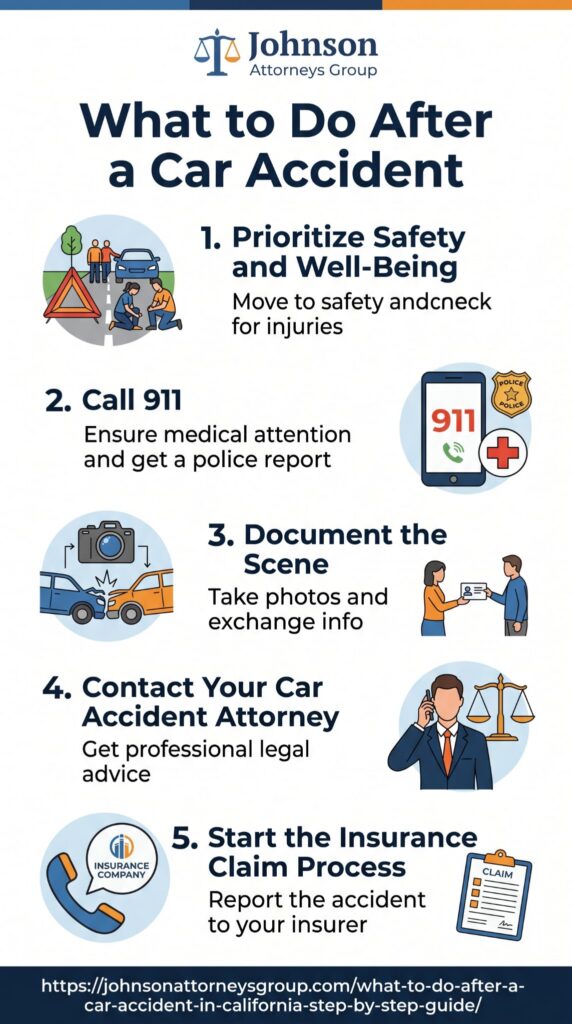
Prioritize Safety and Well-Being
Your first priority is safety. If the vehicles can be moved and no one needs emergency help, move out of traffic to a safe location. California law allows a driver involved in a property-damage-only crash to stop at the nearest location that will not block traffic or put other drivers at risk. Turn on your hazard lights and stay aware of traffic around you.
Check yourself, your passengers, the other driver, pedestrians, bicyclists, and anyone else involved. If someone is hurt, do not try to move them unless there is an immediate danger. California law requires a driver involved in an injury accident to provide identifying information and give reasonable assistance, including arranging transportation for medical treatment when it is apparent that treatment is needed or when an injured person asks for it.
Get medical attention even if you think the injury is minor. Pain, concussion symptoms, soft-tissue injuries, and internal injuries may not be obvious at the scene. Medical care also creates a record that can help connect the injury to the crash if you later need to bring a claim.
Call 911
Call 911 if anyone is injured, if a vehicle is blocking traffic, if a driver appears impaired, if there is a dispute at the scene, or if the crash created a dangerous condition. A police or CHP response can help protect everyone at the scene and create an official record of what happened.
California also has separate accident-reporting rules. If the crash caused injury, death, or property damage over $1,000, the driver must report the accident to the DMV within 10 days on an approved form. This is commonly called an SR-1. The SR-1 is separate from any police report, CHP report, or insurance report.
Do not leave the scene before you have fulfilled your duties. At minimum, exchange the required information with the other driver or property owner. If someone is injured, provide your name, address, vehicle registration number, owner information, and requested license information to the other party and to any officer at the scene.
Document the Scene
If it is safe, document the accident before vehicles are moved or repaired. Take photos and video of the vehicle positions, damage, license plates, traffic signals, skid marks, debris, road conditions, weather, lighting, and visible injuries. If the crash happened near a business, intersection, parking lot, apartment complex, or freeway ramp, look for cameras that may have recorded the collision.
Exchange insurance, registration, license, phone number, and address information with the other driver. Get names and contact information for witnesses. If police or CHP respond, write down the responding agency and officer information so you can request the report later.
Keep every document connected to the crash. This includes medical records, discharge papers, prescriptions, repair estimates, towing records, rental car receipts, insurance letters, and photos. If you are hurt, continue treatment and follow your doctor’s instructions. Gaps in treatment can make it easier for an insurance company to dispute the injury.
Contact Your Car Accident Attorney
One of the first calls you should make after a serious car accident in California is to a car accident attorney. You may need help before speaking with the other driver’s insurance company, giving a recorded statement, signing a release, or accepting a settlement.
At Johnson Attorneys Group, we review the crash, identify who may be responsible, and look for the evidence needed to support your claim. That may include police reports, witness statements, photos, video, medical records, repair evidence, insurance coverage, and expert review when needed.
We can also help you understand the filing deadline. In many California personal injury cases, the lawsuit deadline is two years from the injury. If a public entity may be involved, such as a government vehicle, public employee, dangerous public road condition, or other public-agency issue, a government claim may need to be presented within six months.
Starting early matters. Video can be deleted, witnesses can become harder to reach, vehicles can be repaired, and insurance companies may begin building their defense right away.
Start the Insurance Claim Process
Notify your own insurance company after the crash. Most policies require prompt notice, even if another driver caused the accident. When you report the crash, give the basic facts. Do not guess, exaggerate, admit legal fault, or give opinions about injuries before you know the full medical picture.
The at-fault driver’s insurance company may contact you quickly. Be careful with recorded statements. The adjuster may ask questions designed to limit fault, minimize injuries, or create inconsistencies. You can speak with a lawyer before responding.
If the crash caused injury, death, or property damage over $1,000, make sure the SR-1 issue is addressed. Filing an insurance claim does not replace the DMV SR-1 requirement. Filing an SR-1 also does not file a lawsuit or preserve your right to sue.
Before accepting a settlement, make sure the full claim has been reviewed. A fast offer may not include future medical care, lost income, reduced earning capacity, pain and suffering, or long-term effects from the injury.
Call JAG After Your Car Accident in California
The steps after a California car accident can seem simple, but the details matter. You may need to protect your health, report the crash, preserve evidence, deal with insurers, and watch legal deadlines at the same time.
Johnson Attorneys Group represents injured people throughout California. We can review what happened, explain your options, handle insurance communication, and pursue the compensation supported by the evidence. We do not charge attorney fees unless we recover compensation for you. You can visit us at our offices in Bakersfield, CA at the Cal Twin Towers on California Avenue and Newport Beach, CA on MacArthur Blvd.
Call 1-800-208-3538 for a free case review.